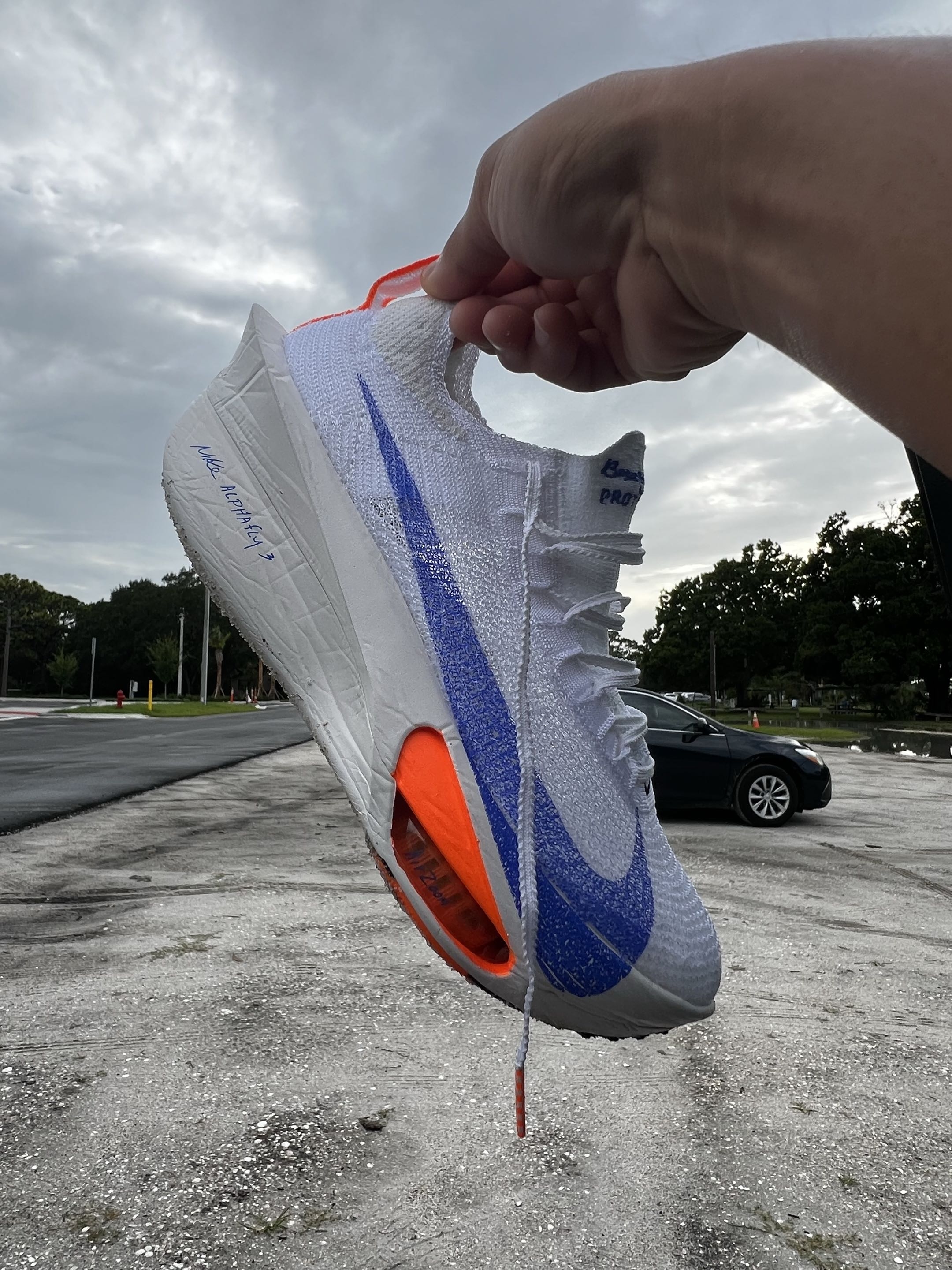
 Nike Alphafly 3 in the white/blue Blueprint colorway, held up against an overcast Florida parking-lot sky.
Indy is November 7.
I picked Indianapolis Monumental for two reasons. The first is the weather — early November in Indiana is cool, which matters a lot when you train through Florida summers. The second is the course itself: USATF-certified, flat, and quietly minting Boston qualifiers since 2008. If I'm chasing 3:15, I'm not going to do it on a humid course with rolling hills. Weather and course were the first two levers I picked. The shoe is the third.
I've been putting off the carbon-plate question for a while. Not because I didn't have an opinion. More because every shoe review I'd read sounded like it was written by the same person, and that person was getting a free pair. I wanted real data before I dropped close to $300 on a pair of shoes I'd only use a couple times.
A 2026 meta-analysis finally gave me something to work with. 14 studies, 271 runners, pooled together. Here's what it actually says, and what I'm doing with it.
01 / What the number is
Carbon-plated shoes cut metabolic cost by about 2.75% on flat road. Translated to race time, that's roughly a 1% improvement on the clock.
For a 3:40 marathoner chasing 3:15, 1% is around two minutes. That's not nothing. But it's also not twenty-five minutes. The shoe doesn't close the gap between where I am and where I want to be. The training does. The shoe is the last 8%.
I want to be honest about that, cause the way shoes get sold makes it sound like the plate is the whole story. It isn't. The plate is a small, real edge on top of a lot of unsexy mileage.
02 / The asterisks
Two things in the data that surprised me.
Plate shape matters more than I thought. Curved plates gave a 3.45% economy gain. Flat plates gave 0.19%. That's basically the difference between a real tool and a label on a box. Not every "carbon-plated shoe" is the same thing.
The foam matters as much as the plate. PEBA foam — the stuff in the Vaporfly and Nike Alphafly 3{rel="sponsored nofollow"} — loads and unloads efficiently with each stride. EVA and TPU foams don't, even with a plate inside them. The plate and the foam are a system. One without the other is half the shoe.
The other thing the analysis points out: elites get less out of the shoe than recreational runners do. Their stride is already efficient, so there's less for the shoe to fix. The bigger gains go to people like me, whose form starts breaking down somewhere in the back half of a marathon and could use the help.
03 / Probably Alphaflys
The shoe is still up in the air, honestly. But if I had to pick today, it'd be Alphaflys.
The reasoning is pretty boring. Curved plate, ZoomX PEBA foam, dual Air Zoom pods in the forefoot — the full system the meta-analysis was actually measuring. It's also the shoe I already have an old pair of, which I'll keep using for marathon-pace workouts in the final block so my legs know what they feel like.
I'll prob still poke around the Metaspeed lineup and the new adidas options before I commit. But the Alphafly is the safe default — known geometry, known foam, a shoe I've already run in. The new pair, when I do pull the trigger, stays in the box until race week. Alphaflys lose their snap fast — maybe a hundred good miles before the foam goes flat. No reason to waste that on training runs.
I'm not gonna pretend the shoe is the difference between hitting 3:15 and not hitting 3:15. It isn't. The 5am alarms are. The long runs in the Florida soup are. The honest workouts are. The shoe is two minutes on top of all of that, and I'll take two minutes.
04 / Who should care
If you're picking a race-day shoe, the meta-analysis points at three things to look for:
- Curved plate, not flat. This is the actual lever.
- PEBA foam (or equivalent — Nike calls it ZoomX, adidas calls it Lightstrike Pro). The foam does half the work.
- Road only. On trails the rigid plate disrupts your stride and the analysis showed it can actually make you slower. Trail running is a different shoe conversation.
And the honest bit: don't expect the shoe to do the training for you. It won't. It'll give you the last little bit on the day you need it. Everything else is on the mornings nobody sees.
November 7 is five months out. The weather's right. The course is flat. The shoes are probably picked. The work is the work.